Independent practical guide

Insurance for 2 Cats

Two cats can have separate benefits or a shared arrangement; establish the structure before adding premiums or applying a discount.

Policy-first Independent Useful checks
Key checks

What matters on this page

Use these checkpoints to frame the literal question before reading the full guide.

Two identities Separate medical histories
Two structures Individual or shared
Two claims Track the remaining benefit
Direct answer

For 2 cat insurance, first ask whether each cat has its own deductible and limit or whether the contract pools them. Both structures exist in current public provider descriptions. Keep each cat’s age, history and eligibility separate even when billing or benefits are combined. A household discount does not by itself mean one shared insurance pot.

The sections below show how to verify the answer and what can change it.

Do the cats need different settings?

If one cat needs a different limit or deductible, begin with individually selected benefits. If the household prefers one shared structure, inspect how one cat’s claim affects the other’s remaining protection. Do not infer that matching species or living at one address makes the cats interchangeable for underwriting.

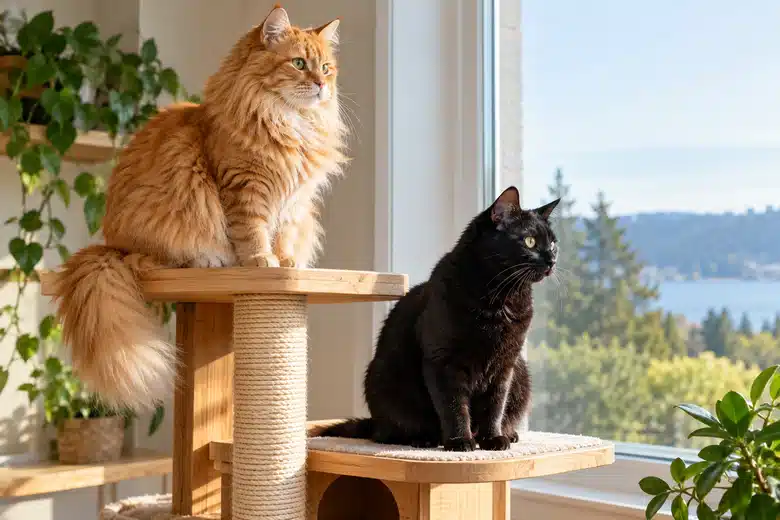
Orange longhair and black shorthair cats sitting on separate shelves near a window
Two cats can share a home while retaining separate medical histories and insurance needs.
Evidence matrix

Actual structures described by providers

Provider example Deductible and limit Discount boundary Unknown
Pets Best additional pet Own annual deductible, limit and reimbursement FAQ advertises qualified multi-pet savings; underwriter and plan restrictions Both cats’ actual schedules and price
MetLife Pet Family Plan Shared deductible, annual limit and reimbursement rate Family discount subject to eligibility; separate multi-policy discount does not combine State offer, both cats’ eligibility and charge

Pets Best additional pet

Deductible and limit Own annual deductible, limit and reimbursement
Discount boundary FAQ advertises qualified multi-pet savings; underwriter and plan restrictions
Unknown Both cats’ actual schedules and price

MetLife Pet Family Plan

Deductible and limit Shared deductible, annual limit and reimbursement rate
Discount boundary Family discount subject to eligibility; separate multi-policy discount does not combine
Unknown State offer, both cats’ eligibility and charge

Official pages were checked October 8, 2026. The Pets Best FAQ advertises a 5% multi-pet discount with plan and same-underwriter qualifications. MetLife’s page distinguishes a Family Plan from separately discounted individual policies. Neither summary proves a discount or price for a particular pair of cats.

Follow two invented claims through the deductible

Suppose Cat A has $900 and Cat B has $600 of fully eligible expense in the same term. With separate $250 annual deductibles and 80% reimbursement, A receives ($900 − $250) × 80% = $520 and B receives ($600 − $250) × 80% = $280, totaling $800. Both individual limits are assumed sufficient.

With one hypothetical shared $250 deductible and 80% rate, payment on the combined $1,500 is ($1,500 − $250) × 80% = $1,000, assuming sufficient shared benefit. The $200 difference comes from meeting one rather than two deductibles. This illustration is not a quote, a named provider’s claim decision or proof that shared protection is always preferable.

Compare with the details in front of you

Ready to check current rates?

Keep policy terms, deductible, reimbursement and limits beside the quote so the comparison stays consistent.

Find Coverage for Your Pet

Now test the limit instead of the deductible

If a shared plan has only $700 left in available payout benefit, it cannot pay the illustrative $1,000 in full. The exact allocation follows the contract and claim processing. Separate plans may preserve Cat B’s unused limit when Cat A has a large claim, while a shared arrangement may allow a larger portion of the household pool to serve one cat. Decide which risk you can retain.

Checklist

A two-cat decision tree

If either cat has prior signs, stop and review that cat’s history treatment before estimating reimbursement.
If different settings are essential, compare individual schedules and do not assume a family design permits them.
If pooling is acceptable, test one large claim and simultaneous claims against the shared cap.
If a discount is advertised, verify qualification and the final premium for both cats.
If all terms are comparable, add full annual charges and keep a separate reserve for excluded and routine care.

Keep the claim records separable

Ask the clinic to identify which cat received each service. Retain each cat’s history and any shared-limit balance. One account login can make administration easier without changing what evidence is needed for each event. When a new cat joins later, check its start dates rather than borrowing the first cat’s established timeline.

Household offer limitation

No actual two-cat state packet, paired premium or discount acceptance was captured. The page explains sourced structures and transparent arithmetic; the appropriate choice remains dependent on both cats and the issued terms.

FAQ

Common questions

Do two cats always have two deductibles?

No. Separate-per-pet and shared-family designs exist. Read the exact schedule rather than infer the structure from a multi-pet label.

Can one cat use the other cat’s limit?

Only if the contract permits pooled benefits. Individual limits should not be added together as interchangeable money.

Pet Insurance Lens

Ready to compare with clearer inputs?

Keep the policy terms beside the price, then continue to rates when the comparison is clear.

See Insurance Rates